

A double helical gear earns its place in an industrial gearbox when torque is high, noise cannot be allowed to climb, and axial thrust needs to stay under control. A herringbone gear can be the tougher-looking answer on paper, but the continuous V-shaped tooth form leaves less tolerance for casual machining. The better choice comes down to the way the drive loads up, how much room the housing has, and how reliably the tooth form can be produced.
Why the Double Helical Gear vs Herringbone Gear Question Matters
Helical teeth mesh smoothly and carry load across a longer contact path, yet they push along the shaft while they transmit torque. In a compact reducer, compressor drive, or pump gearbox, that side force can become a bearing, housing, and heat-management issue.
A double helical gear answers the thrust problem with two helix directions on one body. One side pushes toward one end of the shaft; the other side pushes back. When the lead, face contact, and alignment are right, the side loads oppose each other instead of piling into the bearing arrangement.
For industrial drives where tooth geometry has to follow the working load, YIZHI MACHINERY custom helical gears keep the discussion tied to duty cycle, installation space, and the contact pattern the gearbox actually needs.
How Each Gear Handles Axial Force
Double Helical Gear with a Center Gap
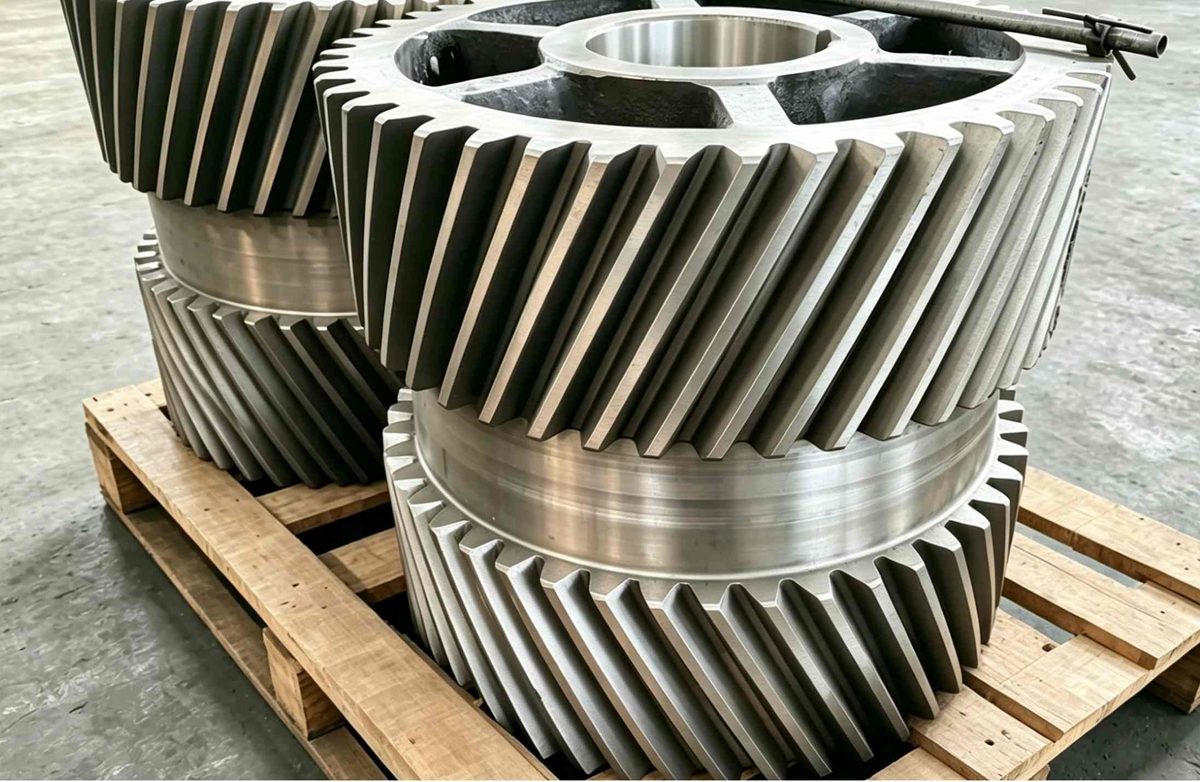
On a double helical gear, the two mirrored tooth sections are divided by a central relief gap. That open band gives the tool a way in and out, which matters during cutting and finishing. It is also the quickest visual clue that the part is not a true herringbone gear.
In service, the mirrored helix directions reduce net axial thrust and take pressure off the bearing arrangement. That does not mean the gear is forgiving. If the two halves do not share load evenly, the gearbox can still develop edge contact, vibration, heat, or uneven wear.
Herringbone Gear with Continuous Teeth
A herringbone gear has a continuous chevron tooth pattern, with no center gap across the face width. The result is a compact, uninterrupted contact path that can be attractive in large equipment where every millimeter of tooth face is expected to work. The visual difference is simple, but the manufacturing difference is not.
The center meeting line has to be formed accurately. A small mismatch there can change the contact pattern, raise noise, or start a wear track that was not obvious during assembly. Herringbone gears reward excellent machining, but they give the process less room to drift.

Load, Noise, and Space in Industrial Gearboxes
Both gear types are used when a simple spur gear would feel too abrupt for the duty. Their angled teeth bring more gradual engagement, which can spread load, soften impact, and reduce noise. The benefit only shows up properly when cutting, heat treatment, finishing, and assembly all support the intended tooth contact.
A double helical gear often wins on balance. It gives the drive smoother running and axial force control, while the center gap keeps certain cutting and finishing operations more manageable. For reducers, pump drives, compressors, and general industrial gearboxes, that tradeoff is often easier to justify than a more demanding herringbone route.
A herringbone gear becomes persuasive when load density is severe, and the machine can justify the extra manufacturing attention. Rolling mills, mining drives, marine propulsion systems, and other heavy machinery may benefit from the uninterrupted tooth form. Even in those cases, the surrounding design still matters: shafts, bearings, lubrication, housing stiffness, and access for service can change the answer.
Manufacturing and Inspection Priorities
Material matters, but tooth accuracy usually decides whether the design behaves as expected. Double helical and herringbone gears both rely on clean lead geometry across two mirrored tooth directions. If one side works harder than the other, the symptoms may show up as heat, noise, edge contact, or early tooth surface fatigue.
Heat treatment adds another layer. Gear projects that use alloy steels such as 20CrMnTi, 42CrMo, 20CrNiMo, and 40CrNiMo are usually chasing a mix of strength, toughness, and wear resistance. Quenching, tempering, carburizing, or induction hardening should be planned with tooth size, distortion risk, case requirements, and later finishing in mind.
When the design calls for a dedicated product route, the double helical gear should be reviewed through module, helix angle, material, heat treatment, and gear inspection rather than treated as a simple left-and-right tooth pattern.
Inspection closes the loop. Tooth profile, lead, pitch, hardness, and dimensional relationships all influence how the gear behaves after installation. Grinding, ID and OD work, keyways, broaching, honing, and final gear inspection are not separate chores; they are the route back to the intended contact pattern.
Choosing the Gear Around the Application
A double helical gear is a strong candidate when the drive needs torque capacity, reduced axial thrust, manageable production complexity, and restrained noise. It is especially useful when the gearbox can accept a center gap and future serviceability matters. The design suits many medium-heavy and heavy-duty machines without making every detail depend on the hardest tooth form to manufacture.
Choose a herringbone gear when uninterrupted tooth contact is more valuable than process simplicity. That may be true in high-power industrial drives where the gear face carries serious load, and the layout benefits from a continuous chevron form. The result can be excellent, but it asks more from machining, inspection, and assembly.
The machine environment should have a vote too. Mining equipment values shock resistance and wear control; metro systems put safety and reliability first; pump drives need steady transmission and long service life. A useful gear choice is always tied to where the gear has to live.
Where YIZHI MACHINERY Fits in Custom Gear Selection
YIZHI MACHINERY fits best when the gear decision is already technical. A transmission system may involve custom helical gears, gear shafts, spiral bevel gears, internal gears, worm gear sets, or precision-machined parts in the same assembly. That breadth is useful when the gearbox depends on matched components rather than one isolated gear.
For double helical and herringbone-style work, the value sits in process control. Gear cutting, milling, heat treatment, grinding, inspection, and feature machining all have to agree with the intended contact pattern. A team that understands both gear geometry and downstream machining can reduce the small mismatches that become larger problems under load.
The strongest selection conversations are practical. Start with shaft arrangement, duty cycle, torque behavior, target noise level, lubrication, bearing space, and the likely inspection method. From there, YIZHI MACHINERY can position the gear form around the way the equipment actually runs.
Conclusion
A double helical gear is not simply a heavier helical gear, and a herringbone gear is not automatically the premium answer. Both manage axial thrust through mirrored helix directions, but they differ in manufacturability, center geometry, inspection sensitivity, and service fit. The right gear gives the industrial gearbox stable contact, controlled noise, realistic production, and dependable operation in its working environment.
For a gear solution shaped around real drive conditions, contact YIZHI MACHINERY and match your gearbox requirements with the right custom gear path.
FAQ
Q: What is the main advantage of a double helical gear?
A: Its main advantage is thrust balance without giving up the smooth mesh of helical teeth. The left-hand and right-hand sections push against each other, so the bearing system is not left carrying the full side load. In practice, that can make a medium-heavy gearbox feel calmer under steady torque.
Q: Is a herringbone gear the same as a double helical gear?
A: They are related, but they are not the same part. A double helical gear usually has a center gap between mirrored tooth sections. A herringbone gear brings the V-shaped teeth together at the center, which changes the machining route, inspection work, and use of face width.
Q: When should an industrial gearbox use a herringbone gear?
A: It makes sense when load density is very high and the application benefits from continuous tooth contact across the face. Large machinery, mining drives, rolling equipment, and marine transmission systems may justify it. The design is strongest when the project can support demanding machining and inspection.
Q: What should be checked before choosing a custom helical gear?
A: Start with torque behavior, speed, duty cycle, shaft arrangement, bearing space, lubrication, target noise level, material, heat treatment, and inspection method. Those details quickly show whether a double helical gear, herringbone gear, or another gear form gives the drive the best chance of stable service.
