
Gears and shafts have different functionalities and serve different purposes. However, when we put both gears and shafts together in one machine element, we end up with the gear shaft, which is a combination of the characteristics of a gear and a shaft. A buyer should provide the complete operating requirements and drawing data before asking for a price. YIZHI MACHINERY develops customized gear shafts, gears, transmission components, and machined parts for industrial and commercial equipment.
Define the Gear Shaft’s Duty Before the Geometry
Gear Shaft Duty
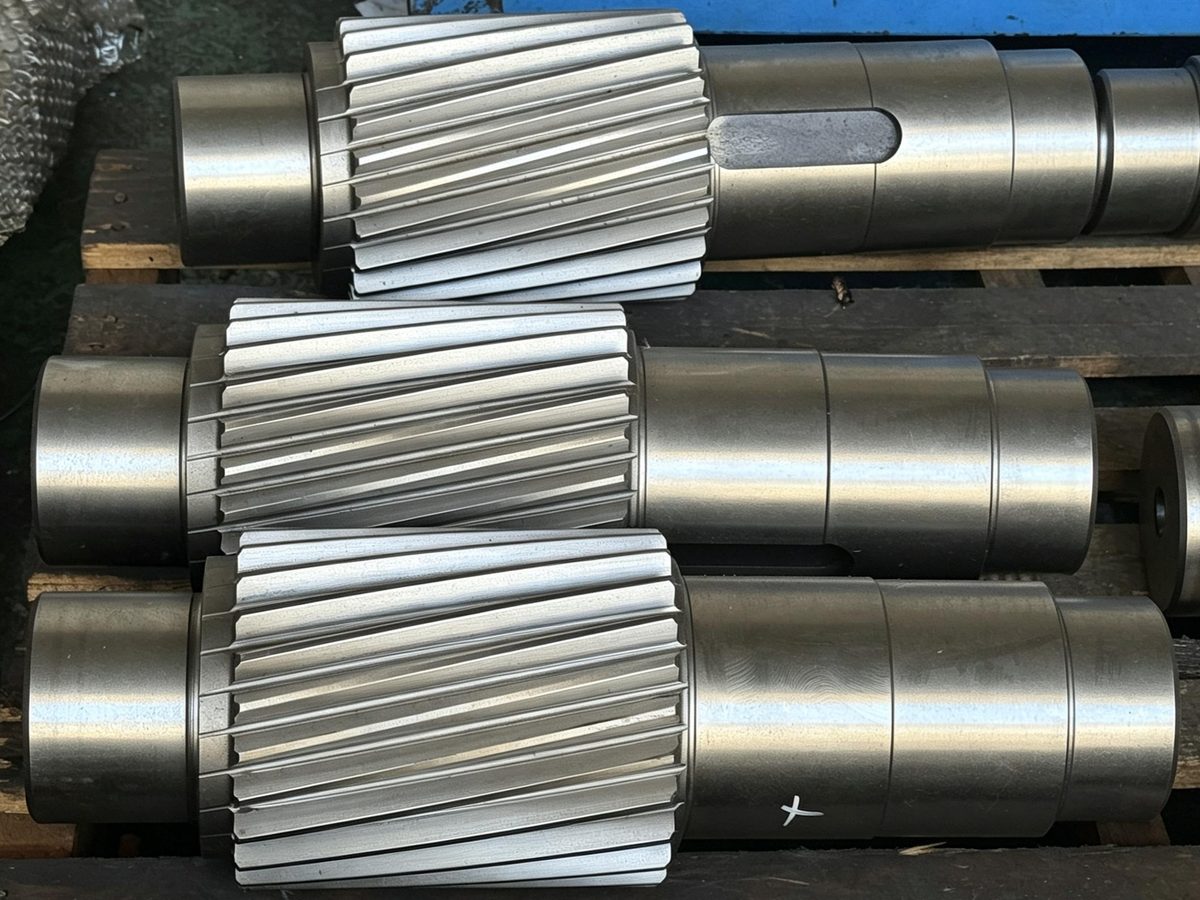
Torque, speed, duty cycle, shock loading, direction change, temperature, lubrication, useful life, and the amount of space in the housing or machine will be your first considerations. A shaft that turns in a precision gear reducer will likely need a different alloy, shape of teeth, and heat treatment than a shaft that operates in mining, agriculture, pumping, or industrial drives.
Your drawing should show the kind of gear or spline involved, the module or diametral pitch, number of teeth, pressure angle, helix angle, face width, reference diameters, shaft journals, keyways, shoulders, fillets, and datum system. Always include mating component or assembly information when you can, since gears and shafts do not operate independently.
Select the Spline and Gear Interface
Spline and Gear Interface
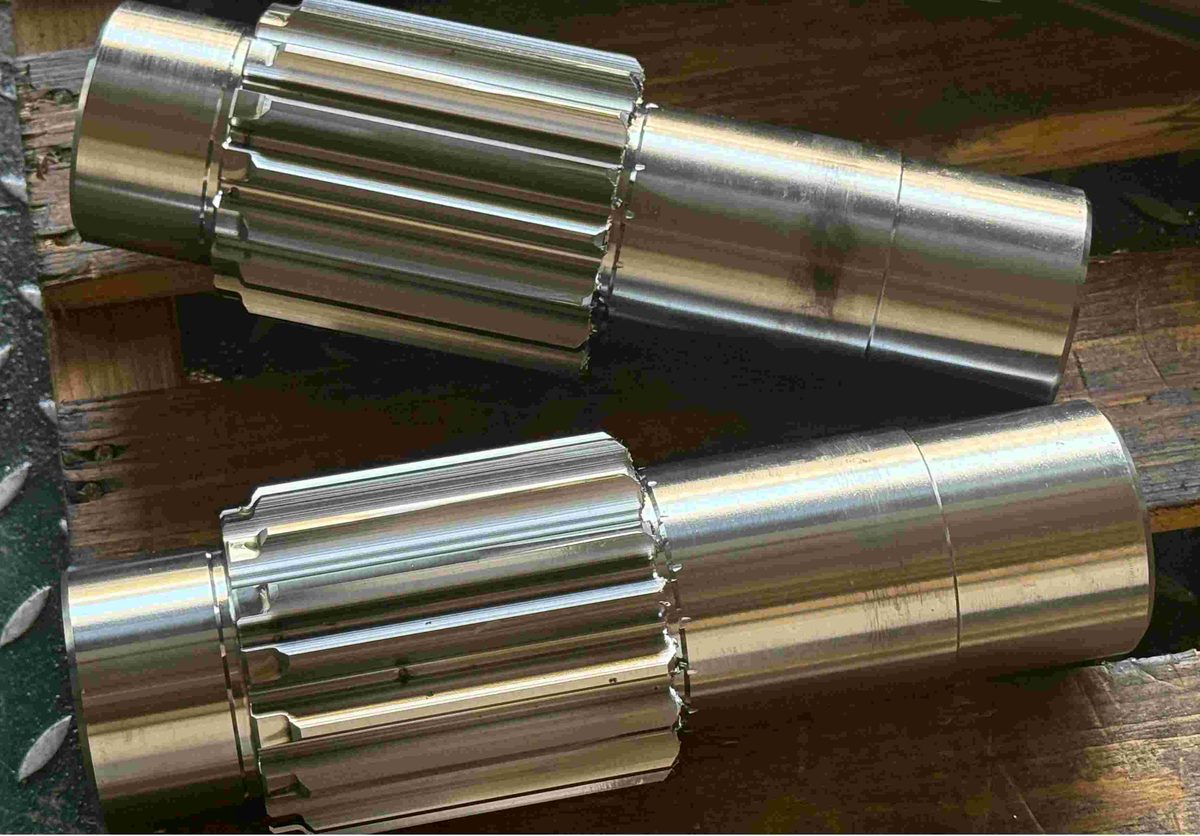
A gear shaft may use an involute spline, a keyed section, a gear formed directly on the shaft, or another torque-transfer interface. The choice affects assembly, backlash, load distribution, serviceability, and manufacturing cost. Spline details should include tooth form, major and minor diameters, effective length, fit, centring method, and inspection requirements.
An integrated gear shaft removes the assembly clearance between a separate gear and shaft and can improve rigidity and transmission accuracy. It can also make repair more expensive because the complete part may need replacement. The buyer should compare the benefit of integration with the service strategy and expected failure mode.
Choose Material for Strength and Wear
Material Strength and Wear
Material selection depends on the required core toughness, tooth hardness, fatigue strength, wear resistance, corrosion environment, and heat-treatment route. High-grade steel and alloy materials are commonly considered for demanding transmission parts, but the final grade should be selected based on the actual load and service conditions.
The specification should separate the material certificate, chemical composition, initial condition, heat-treatment target, hardness location, and acceptance method. Avoid a vague requirement such as hardened steel. The supplier needs to know whether the priority is a hard tooth surface, a tough core, dimensional stability, or a combination.
Control the Machining Sequence
Machining Sequence
Gear shaft manufacturing may involve turning, milling, drilling, gear hobbing, shaping, broaching, keyway machining, grinding, honing, and heat treatment. The order matters because each process can change the datum, stock, runout, or surface condition used by the next process. A stable sequence reduces the chance that a part meets individual dimensions but fails in assembly.
YIZHI MACHINERY describes advanced gear machining and inspection capabilities, including hobbing, shaping, grinding, broaching, cylindrical grinding, honing, milling, drilling, and heat treatment. Ask which operations are internal, how fixtures establish the datum, and how the supplier controls deformation or stock after heat treatment.
Use Heat Treatment to Balance Surface and Core Performance
Heat Treatment Balance
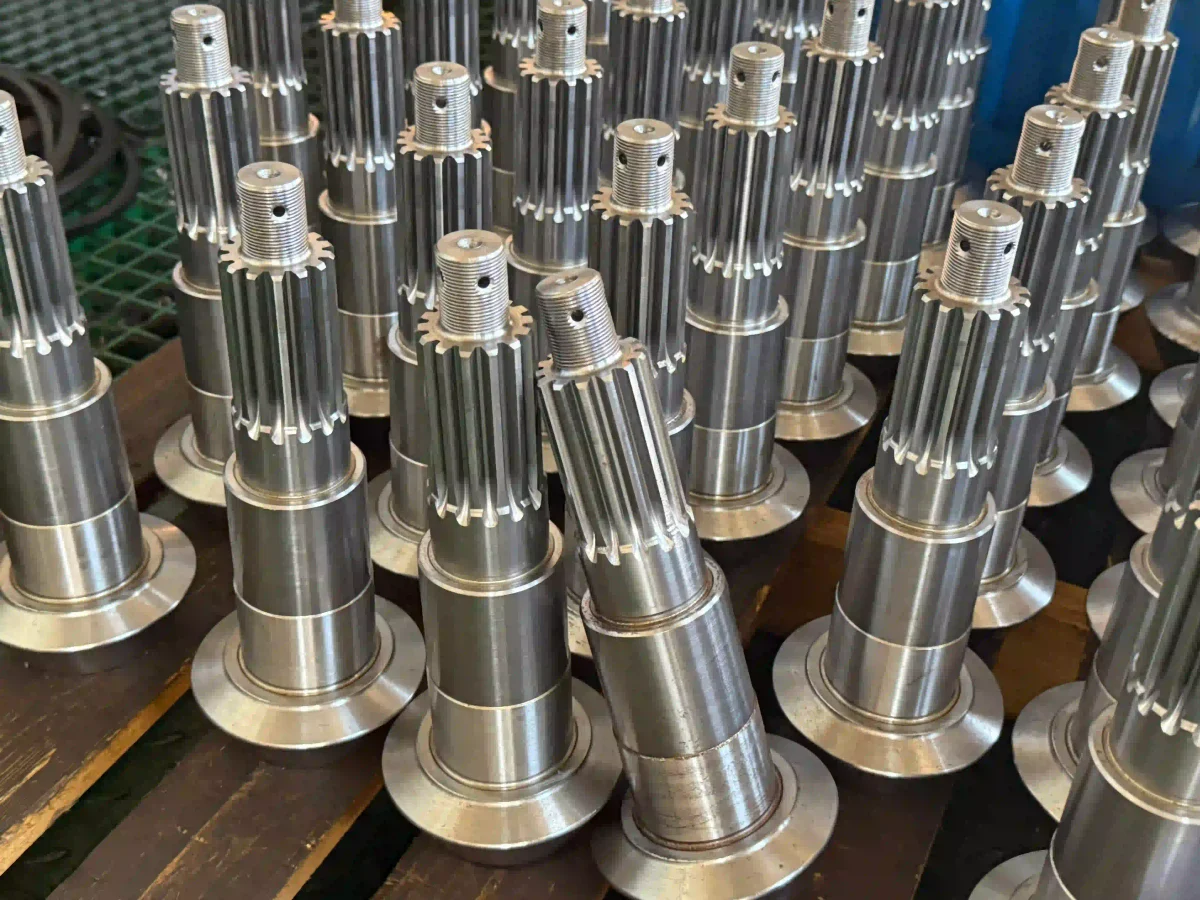
Heat treatment can increase tooth wear resistance and fatigue performance while retaining the core toughness needed to carry torque and impact. Depending on the design, the route may include carburizing, induction hardening, quenching, tempering, or another controlled treatment. The correct route depends on material, geometry, hardness depth, and service load.
The drawing should state the hardness requirement, effective case depth if applicable, transition or core condition, distortion limit, and sampling method. Heat treatment is not complete when the furnace cycle ends. Post-treatment inspection and any required grinding or honing are part of the final dimensional process.
Inspect Tooth Geometry and Shaft Datums Together
Geometry and Datum Inspection
Critical inspection should cover dimensions, tooth profile, pitch, runout, surface roughness, helix or lead, concentricity, and tooth contact accuracy. The shaft journals, shoulders, splines, and gear teeth must be measured relative to the same functional datums used by the assembly. Otherwise, a tooth profile can pass while the assembled gear still runs eccentrically.
Inspection planning should state the instrument, calibration, sampling frequency, report format, and defect response. YIZHI MACHINERY describes comprehensive checks of key gear parameters and micrometre-level dimensional control through precision equipment. The buyer should request the actual report fields and the tolerance interpretation for the selected gear shaft.
Check Assembly Fit and Functional Contact
Assembly Fit
A gear shaft should be tested with its mating gear, bearing, seal, housing, or fixture whenever the assembly affects performance. Check insertion force, spline engagement, backlash, endplay, runout, contact pattern, noise, vibration, and lubrication access. A physical fit test can reveal a datum or chamfer problem that is difficult to see in a dimensional report.
For a new OEM project, approve a sample or first article before mass production. Confirm the material, heat treatment, finish, marking, packaging, and inspection report. If the mating component changes, the gear shaft may need a new review even when its drawing number has not changed.
Evaluate the Supplier’s Customization Process
Customization Process
A suitable custom gear shaft supplier should be able to translate an application into a drawing review, material proposal, process plan, sample, inspection record, and repeat-order control. YIZHI MACHINERY uses a solution-based OEM approach for gears, gear shafts, planetary gears, double helical gears, spiral bevel gears, internal gears, and precision machined parts.
Ask how engineering questions are recorded, how drawing revisions are controlled, how substitutions are approved, and how nonconforming parts are handled. Good communication is part of the manufacturing process because a small change in spline fit, heat treatment, or datum can change the result of the complete transmission.
Plan Packaging and Corrosion Protection
Packaging and Corrosion Protection
Precision gear shafts can be damaged by impact, contamination, moisture, and uncontrolled contact between teeth. Define rust prevention, protective caps, separators, orientation, labels, batch traceability, and carton handling. The package should protect journals, splines, and tooth flanks without introducing residue that affects assembly or lubrication.
Repeat orders should use the approved drawing revision, material certificate, heat-treatment record, inspection plan, and packaging standard. This makes it easier to distinguish a design problem from a process change, transport damage, or an assembly issue in the field.
Conclusion
Gear shaft manufacturing requires the gear interface, shaft alignment, material, machining sequence, heat treatment, inspection, assembly fit, and packaging to work together. Define the operating load and functional datums first, then approve a representative sample and report. YIZHI MACHINERY can be considered for custom gear shafts when the project is controlled by a complete drawing and application-specific acceptance plan.
FAQ
Q: What information is needed for a custom gear shaft project?
A: Submit the drawings or samples, dimensions of gears or splines, material used, heat treatment, hardness, tolerances, surface finish, torque, speed, duty cycle, mating parts, quantity, inspection requirements, and packaging information. Include the assembly environment and service conditions when the shaft is used in a demanding transmission.
Q: Why is heat treatment important for gear shafts?
A: Heat treatment can improve tooth wear resistance and fatigue performance while preserving the core toughness needed for torque and impact. The route must match the material and geometry. Specify hardness, case depth or hardened zone, distortion limit, and post-treatment inspection rather than using a general word such as hardened.
Q: Should gear shafts be inspected with the mating gear?
A: Whenever assembly impacts contact, backlash, alignment, or runout, a functional fit test is useful. The dimensional test ensures that the part fits its drawing, while the mating test reveals how the entire interface acts. Apply both when the gear shaft is a crucial transmission element.
