
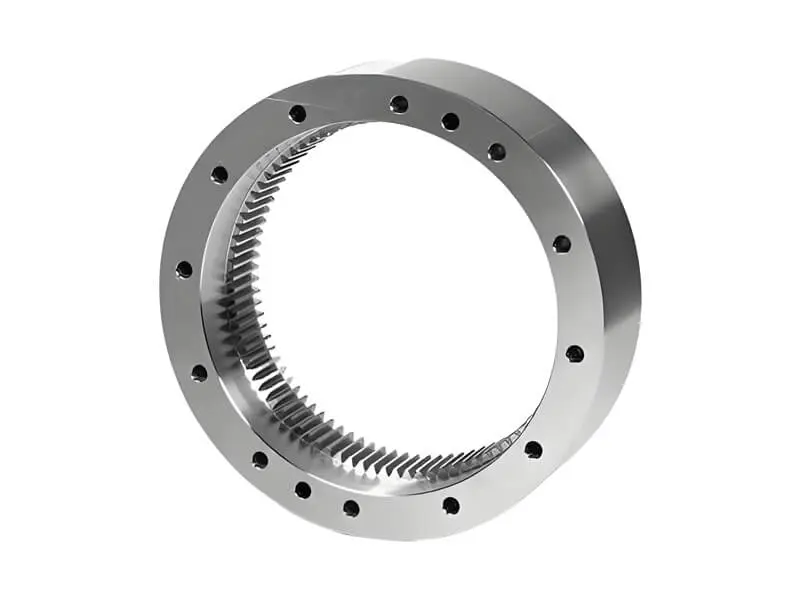
What is an Internal Gear, and how is it structured?
In the field of power transmission, internal gears are provided with teeth cut into the inner surface of the ring. The internal gear then engages with an appropriate pinion, which is located inside the ring, enabling the system to be compact. YIZHI MACHINERY’s internal gears are made from high-quality steel alloys and are designed to withstand arduous service in various plants and factories.
How does it differ from a standard external gear?
An internal gear turns in the same direction as the pinion it meshes with. External gear pairs turn in opposite directions. The tooth shape on an Internal Ring Gear is the reverse of an external gear, so more teeth stay in contact and power flows more steadily through the mesh.
What are the main types of Internal Ring Gear designs?
Why choose Spur Internal Gears for parallel shafts?

Straight-cut internal spur gears have straight-cut teeth parallel to the shaft. The action of the straight cut teeth creates no side force on the bearings. Internal spur gears are suitable for medium-speed work as the simple form of the teeth is easy to cut. They give excellent results for production in quantity, running in batches.
How do Helical Internal Gears provide smoother operation?

Helical internal gears have their teeth cut at an angle. This results in teeth engaging one after another instead of all at the same time. The gradual engagement of the teeth during the meshing process results in a lower noise and vibration level, especially in applications where the drive is running at high speeds and is subjected to heavy loads.
Why should you use an Internal Ring Gear in your next project?
How does the compact design save mechanical space?
With the pinion sitting inside the ring, the two shafts are brought closer together, in a smaller floor space, yet producing high torque. This layout is ideal for use in robot and automation projects where space is a problem, as every inch counts.
Why do internal gears offer higher load-carrying capacity?
An internal gear tooth is in contact with the opposite tooth over a greater surface area than an external gear tooth of the same size. This increased contact area spreads the load on the gear teeth, allowing them to last longer under heavy use. To increase the load-bearing capacity of internal gear applications, YIZHI MACHINERY uses 42CrMo steel for mining and other plant applications.
How do they reduce axial thrust and vibration?
The uniquely curved shape of the tooth face has a very low side thrust force, so it does not exert any excessive forces on shafts and bearings. In addition, the broad contact face delivers a smooth running property even when there are small variations in speed.
How does an internal gear manufacturer ensure high precision?
To reach today’s limits of machine construction, an internal gear manufacturer has to set very tight size limits.
What are the primary manufacturing methods, like Shaping and Broaching?
Cutting internal teeth requires some special consideration. The main method for cutting internal teeth is Gear Shaping. This process uses a unique cutter that oscillates back and forth in order to cut out the internal tooth space of the gear. Since this process can be used to cut a wide variety of sizes, it is one of the most commonly used methods for cutting internal teeth.
An alternative method for cutting internal teeth is Gear Broaching. This process uses a long broach that is pulled through the entire depth of the blank in a single stroke of the tool. The result is a very clean cut. Following either of these processes, the gears are then CNC turned to exact diameter in microns.
Why is Gear Grinding essential for Grade 5-8 accuracy?
After heat treatment, the tooth surfaces are ground in small increments. This process step brings the gear surfaces up to the quality of ISO 1328 Grade 6–8. In some cases, even Grade 5 can be achieved. Thus, the surfaces of the teeth are smoothed, and the friction is reduced, thereby extending the service life of the gear.
How does heat treatment enhance durability?
The surface of gears is hardened by carburizing and quenching, and the core remains tough. This is how YIZHI MACHINERY treats gears: the teeth are wear-resistant but still won’t crack under shock loads in mines and steel mills.
What are the most common applications for an internal gear?
How are they used in Planetary Gear Systems?
The internal gear of a planetary reducer is the outer ring of the planetary gears. This allows for large amounts of torque in a very small package and many different ratios.
Why are they critical for Mining, Metro, and Robotics?
The gears for the Mining machines are designed to operate in a dusty environment and be shock-resistant. The Metro drives are made with alloy steels to be strong and run quietly. Small internal gears are used in the Robot joints, allowing for a compact arm while precise position holding is achieved.
How to find a reliable internal gear manufacturer for custom needs?
The right partner for you makes sure to hit both your size and accuracy targets every time. At YIZHI MACHINERY, we have a completely custom approach from the first time we talk with you about your needs until the time your custom internal gears and related precision-machined components are shipped to you.
What customization services does YIZHI MACHINERY offer?
Customers start with a short call to list size, material, and tolerance needs. The engineering team then draws the part and confirms details. Once approved, the shop cuts, grinds, and treats the gear to the agreed spec. Finished parts ship worldwide, including North America, Europe, and Southeast Asia.
Conclusion
Most modern drives contain internal gears. These deliver large amounts of torque in a small space. Partnering with a specialized manufacturer of internal gears like YIZHI MACHINERY is therefore very effective. Our in-house precision machining and a wide range of proven materials will guarantee a long lifespan of the gears. YIZHI MACHINERY is also currently working with customers like Viktor Tsurkan, TechDrive Solutions, and Precision Motion Systems. We are ready to help you develop a reliable drive system.
FAQ
Q: What level of machining precision can YIZHI MACHINERY gears achieve?
A: With our CNC grinders and strict inspection, the gears of YIZHI MACHINERY can be ISO 1328 Grade 6–8, and some parts can even be Grade 5.
Q: Why is YIZHI MACHINERY considered a trusted internal gear manufacturer?
A: YIZHI is considered a trusted internal gear manufacturer because it has supplied major customers over the long term and received repeat orders for more than three years, supported by consistent quality and service.
Q: How do you check an internal gear prior to shipping to ensure quality?
A: Each gear is checked on a CMM for dimensions and then undergoes Non-Destructive Testing to check for any hidden cracks prior to shipping from our plant.
Q: How long is the lead time for a custom internal gear from YIZHI MACHINERY?
A: The lead time for a custom internal gear will depend upon the specific size and finish. We can, however, give you a firm date once we have confirmed all the details for your order and responded to any questions you may have within 1 day.
